
Visit the Alhambra in Granada Spain
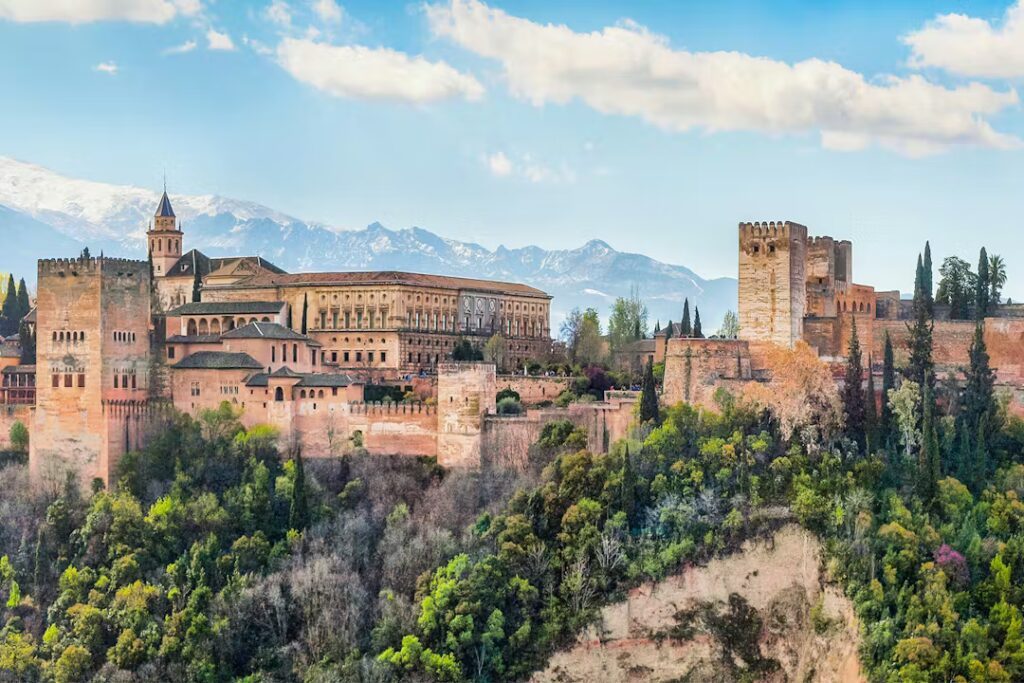
It is magic visiting the Alhambra in Granada, in southern Spain at the base of the Sierra Nevada mountains, which remains impressed in the mind of the visitor as a play of light and cut stone and water. You reach the hill of Sabika, and the palace stands above us with the strength of a fortress and the beauty of a garden which is suspended. It is entering the world where centuries of history, art and experience between various cultures can be read in every detail. After having gone through the monumental enclosure, the Alhambra seems to be a fortified city, the so-called red fortress because of the warm hue of its walls which on sunrise and sunset appear to be on fire in the sun. The walks wander along with cypresses, oleanders and pomegranate trees, and as you go you are accompanied by the song of birds and the low murmur of fountains. Nature here is not so much a setting, but a part of the whole, a symbolic feature that brings to mind the Islamic concept of paradise comprised of gardens and running water.
The Palacios Nazaries is the heart of the Alhambra where the rulers of the last Muslim kingdom on the Iberian Peninsula lived. As you enter the Mexuar, the first reception hall, you are at once struck with the lightness of Nasrid art: finely carved stucco, geometrical designs, which appear to touch the heavens, inscriptions that seem to be calligraphic, reminding us of a poem or an ode to God. All the surfaces are full of complicated designs, as though the artist had rubbed stone into cloth. Thence into the Sala de la Barca, and into the wonderful Sala de los Embajadores, whence ambassadors and great persons were formerly entertained. The wooden dome, which is a masterpiece of Islamic art, resembles a wood carved and painted sky with stars. The panorama of Granada, that extends like a natural stage facing the world beyond, is seen through the windows. The sultans, who sat on their divans, upholstered with expensive fabrics, and looked upon their guests with a certain degree of pride, are easy to imagine.
Passing along courtyards and corridors, you arrive at one of the most recognizable spaces of the Alhambra the Patio de los Arrayanes (Court of the Myrtles), with its long pool of water bordered by white marble paving and hedges of myrtle. The palace is perfectly reflected in the still water, a perfect game of symmetry is created, and the breeze creates slight ripples, transforming the scene into almost the unreal, as a painting moving. As you pass under the arcades you are enjoying the closeness of the place, a suspended silence which appears to seal up time. As you walk through these porticoes, you take in all this feeling of silence; what would appear initially as a beautiful thing turns very profound.
The path then takes one to the renowned Patio de los Leones (Court of the Lions), which is, maybe, the most famous of all the complex. The main fountain is supported by twelve marble lions, out of which thinner streams of water run through an incredible hydraulic system of the era. The proportions are ideal, the arches light, the stucco work so delicate, it seems to be lace cut out of stone. The whole courtyard is full of grace and resourcefulness, as though the whole place was planned as one architectural gem.
Exiting the palaces, you proceed to the Alcazaba castle which is the oldest in the Alhambra. This citadel with its high towers and bastions provides splendid panoramic views of the city and the Albaicin quarter that covers the other hillside. To go up to the Torre de la Vela is to quit the civilized world of the royal palaces and enter the defensive aspect of the citadel, where each stone is a reminder of battles and sieges.
The Palace of Charles V, square outside, and with a magnificent circular court inside, is next to the Alcazaba. This Renaissance construction is in contrast to the gentle Moorish curves of the Nasrid palaces, but it also reveals their historical continuity: the transition to the Islamic to the Christian rule, and the fact that the Alhambra became the source of imperial authority.
The sightseeing usually finishes in the Gardens of the Generalife, the old summer palace of the sultans, located on an adjacent hill. The rate is less: glittering fountains, shaded pergolas, perfumed flowers, water-run stairs falling down the steps, in a murmur. The garden colours are altered according to the seasons but the effect is always the same, a place of complete tranquility, between contemplation and beauty.
You walk out of the Alhambra with much more than the recollection of a wonderful work of architecture. It seems as though you have traversed a world where cultures have come together and mingled together forming a masterpiece of its own. A journey in time, in art and to the heart of a place which speaks to this day in its stone, its light and its tales whispered by the wind.
What to See in Alhambra Granada Spain
The Alhambra of Granada is one of the most interesting monumental complexes in Europe. Islamic art in the world is one of the greatest masterpieces. One of the hills that overlook the city and the Darro valley. The Alhambra seems like a castle that surrounds structures, gardens, courts and towers all of which testify to centuries of history, artistic splendor and civilization. Going to the Alhambra is to plunge into a game of light, water and geometrical ornaments that will bring to mind the fantasy of a past, sophisticated and meditative civilisation.
The oldest part of the complex is the Alcazaba, which is one of the first places that you will see during the tour. The military fortress of the Alhambra was constructed to guard the hill and be in charge of the entry gate to the city. The towers, like the Torre de la Vela, are some of the most suggestive views of Granada. The rooftops of the Albaicin district, the Sierra Nevada mountains and the whole of the perimeter of the citadel can be seen from the top. By walking in between the walls, one feels the defensive purpose of the space, though the air of a city within a city. It is here that the stables and soldiers used to reside.
As you enter the very center of the Alhambra, you arrive at the Nasrid Palaces, the real jewel in the complex. These palaces were constructed during the period between the thirteenth and fifteenth centuries and it is the epitome of Moorish art in Andalusia. Each room is a victory of arabesques, plaster stalactites, interwoven arches and Quranic inscriptions which flow like decorative ribbons up the walls. The palaces are the first, the Mexuar, which was formerly the audience hall of the people, and at which the sultan heard his subjects. The inlaid wood covers its rooms, and its very fine stucco work introduce us to the dainty taste of the Nasrid rulers.
Thence to the Palacio de Comares, which is at the head of the grand Throne Room, or the Salon de los Embajadores. This is among the most symbolic spaces in the Alhambra. It has geometric decorations on its walls and poetic inscriptions and the wooden ceiling is carved and consists of thousands of pieces joined together to depict Islamic cosmology. The palace rises above the well-known Patio de los Arrayanes, a rectangular courtyard, with a long central reflecting pool, which reflects the surrounding buildings and generates a game of symmetries that makes one speechless.
The most glorified section of the Alhambra is certainly the Palacio de los Leones which is a singular work of balance and genius. The Patio de los Leones is in the centre and is a courtyard with the slender columns resembling stone filigree. The fountain with twelve sculpted lions, which are the symbols of power and strength, is located in the middle. The chambers that lead to the courtyard are also wonderful: the Sala de las Dos Hermanas, whose dome is hewn out of stalactite sky; the Sala de los Reyes with medieval pictures of chivalric deeds; the Sala de los Abencerrajes, where the legends of the court unfold and its intrigues.
Alongside the Nasrid palaces, one can find the totally opposite structure of architecture: the Palace of Charles V, that was constructed in the sixteenth century following Reconquista. Surprisingly circular inner courtyard and square plan of the floor make this Renaissance building an interesting architectural juxtaposition. It contains within it museums and collections which narrate the history of the Alhambra and Hispano-Muslim art. The Royal Baths are close to the palaces, and they are a witness of the significance of water rituals in Islamic culture. The small star-shaped holes in the ceiling of the thermal rooms create a feeling of a warm and cozy closeness. Previously they were the preserve of the royal family.
Without going about the Generalife, it would be impossible to terminate the visit. The sultans had their summer palace on a neighboring hill, where they were not obliged to attend to court. The Generalife gardens are a success of fountains, water channels, pergolas, cypresses and rose gardens. One of the most photographed sites in Granada is the Patio de la Acequia, where there is a long central canal and jets of water that intersect each other in elegant curves. Mirador del Generalife is an impressive sight of the Alhambra palaces, and it is a continuous conversation between architecture and nature.
Bundle and Save more
Useful info
Opening hours
Day visit runs 08:30 to 18:00 in the cooler season and 08:30 to 20:00 in the warmer season. Night visits run on specific evenings. The Nasrid Palaces are the strict part: you must enter at the exact time printed on your ticket. Closed Dec 25 and Jan 1.
Location
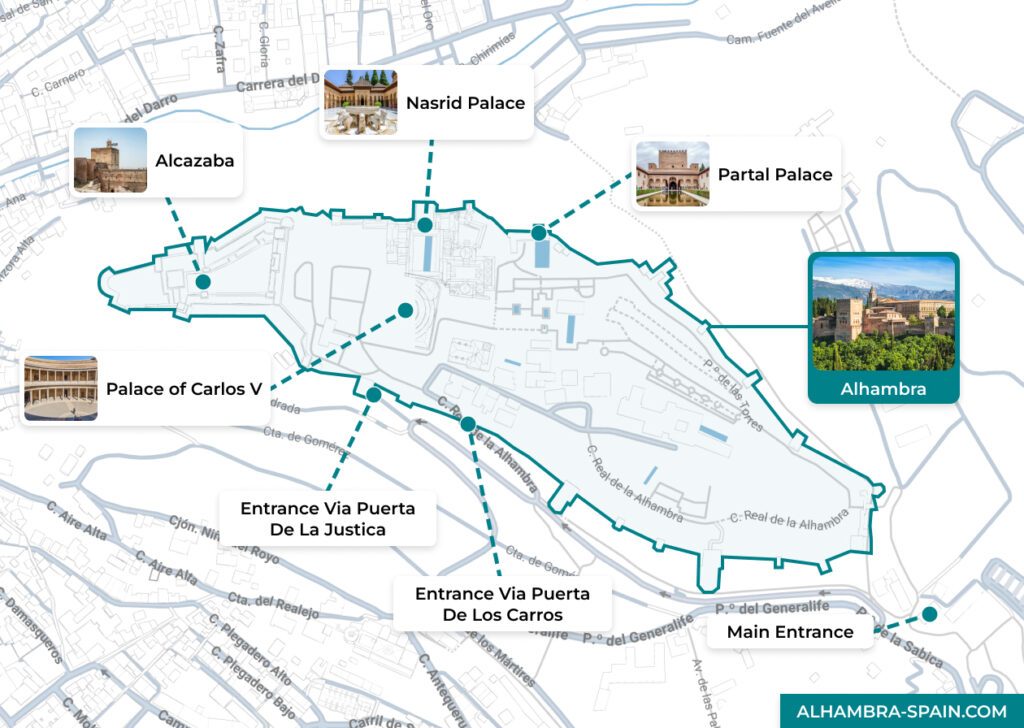
The Alhambra sits on Sabika Hill in Granada. The official address is C/ Real de la Alhambra s/n, 18009 Granada, Spain. It’s a big complex, so arriving with this address saved in your maps app helps you land near the right entrance and ticket areas.
How to get there
From Granada center, take the mini-bus C30 or C32 and hop off at Alhambra-Generalife by the Entrance Pavilion. Walking fans can climb up from Plaza Nueva via Cuesta de Gomérez. Taxi is the easy shortcut. If driving, go via the ring road A-44 then Ronda Sur (A-395) toward Sierra Nevada to the official parking.
Best time to visit
Aim for weekday mornings for cooler air and a calmer vibe in the courtyards. Spring and autumn feel the most comfortable for long walks. Want dreamy photos? Late afternoon light is lovely, but crowds rise, so book earlier and build your day around your Nasrid Palaces time slot.
Duration of the visit
Plan around 3 hours to see the main highlights without speed walking. Guided tours are often listed at about 3 hours too. The key trick is to arrive with breathing room before your Nasrid Palaces entry time, then wander the rest of the complex at your own pace.
Accessibility
Expect slopes, steps, and uneven surfaces, but there are adapted itineraries, ramps in many areas, and lift access to the Palace of Charles V. Wheelchairs can be hired at the Entrance Pavilion if available. There are disabled toilets at the entrance and near Puerta del Vino, plus accessible parking in the monitored car park.
Opening hours
Location
How to get there
Best time to visit
Duration of the visit
Accessibility
Alhambra Map